
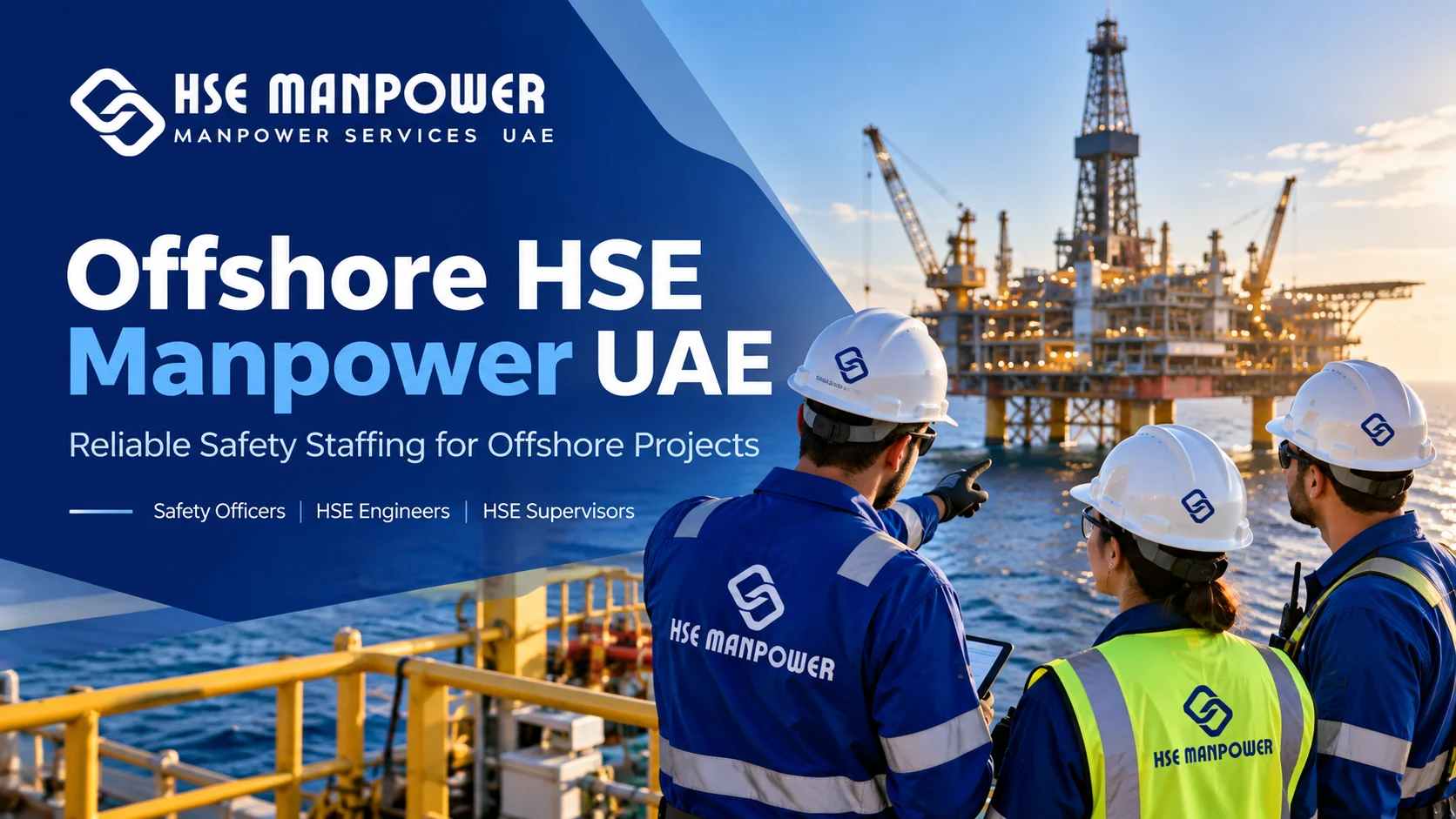
Offshore manpower requirements rarely begin with the words, “We need more people.”
Usually, the real requirement is more specific.
A project is entering a new phase. A shutdown window has been confirmed. Additional contractors are coming onboard. Night-shift coverage has increased. A new offshore campaign is approaching mobilisation. Or a client requires personnel with particular offshore experience, certifications, or site access.
At that point, simply finding CVs is not enough.
Businesses searching for Offshore HSE manpower UAE need safety professionals who can fit the asset, project phase, work scope, and mobilisation conditions, not merely candidates whose job titles match the manpower request.
HSE Manpower supports UAE businesses with project-based HSE recruitment, manpower supply, and outsourcing for offshore, oil and gas, industrial, and other safety-critical operations.
Offshore HSE Manpower Is a Project Requirement, Not Just a Recruitment Requirement
There is a major difference between filling an office vacancy and mobilising someone into an offshore safety role.
An offshore HSE requirement may involve several questions before recruitment even begins:
- What activity will the person supervise?
- Is the requirement for an officer, supervisor, engineer, or manager?
- Is the assignment rotational, temporary, or project-long?
- Does the project require previous ADNOC experience?
- Are offshore certifications or access requirements necessary?
- Will the person support construction, commissioning, maintenance, or shutdown activities?
- Is specialist lifting, process safety, or emergency response experience required?
- How many shifts need HSE coverage?
These details change the type of professional a project actually needs.
That is why HSE manpower planning should begin with the work scope, not with a generic job title.
For procurement teams, EPC contractors and project managers, getting this distinction right can also reduce unnecessary recruitment cycles and help avoid mobilising someone whose experience does not match the operating environment.
Which HSE Professionals Does an Offshore Project Need?
A complete offshore safety structure may involve several levels of responsibility.
Offshore Safety Officers
Safety Officers provide day-to-day field coverage.
Depending on the project, their work can include site inspections, toolbox talks, permit-to-work support, hazard identification, monitoring work practices, reporting unsafe conditions, and supporting compliance with project HSE procedures.
For offshore deployments, relevant offshore exposure and required credentials such as BOSIET, HUET, H2S training, or offshore medical fitness may form part of the manpower specification.
HSE Supervisors
As workforce numbers and simultaneous activities increase, supervision becomes more important.
An HSE Supervisor can coordinate field-level safety coverage, oversee Safety Officers, support contractor control and maintain HSE authority across shifts.
This becomes particularly important where the project is operating around the clock, and a single HSE Manager cannot practically control every field activity.
HSE Engineers
Some offshore risks cannot be handled through field observation alone.
Projects may require engineers for technical work involving areas such as:
- HAZID and HAZOP
- Quantitative Risk Assessment
- LOPA and SIL-related work
- Bowtie analysis
- Fire and gas studies
- Escape and evacuation analysis
- Technical safety documentation
- Construction risk engineering
- Process-safety deliverables
An offshore HSE Engineer therefore fulfils a different requirement from a general site Safety Officer.
Matching these roles correctly helps businesses avoid paying engineering rates for routine field coverage or assigning officer-level manpower to work that requires deeper technical capability.
HSE Managers
At project or operational level, the HSE Manager typically carries broader responsibility for the safety programme.
This may include management-system implementation, project HSE strategy, client coordination, audit preparation, risk-management oversight, contractor performance and reporting to senior project leadership.
For major offshore projects, the Manager provides direction while the engineering, supervisory and officer levels support execution.
Lifting Supervisors and Supporting Safety Personnel
Offshore construction and maintenance frequently involve crane operations, material handling, load-outs and other lifting activities.
Depending on the scope, projects may therefore require lifting supervisors, appointed persons, riggers, or slinger-signallers in addition to the core HSE team.
Requirements can also extend to supporting roles such as:
- Gas testers
- Fire watch personnel
- Confined-space attendants
- Rescue teams
- Banksmen
- HSE trainers
- Environmental personnel
- Emergency-response personnel
- Occupational health staff
The right solution depends on what is happening on the asset rather than how many vacancies appear on the manpower schedule.
Offshore Experience Matters Because Every Asset Has Its Own Reality
Someone can have years of safety experience and still require time to adapt to an offshore environment.
The worksite itself changes the safety equation.
Restricted access, rotational working patterns, marine interfaces, simultaneous operations, lifting activity, confined spaces, hydrocarbon hazards, permit systems, and emergency-response arrangements can all influence the manpower requirement.
Location matters too.
HSE Manpower’s UAE coverage includes offshore and energy-related requirements associated with areas and assets such as:
- Upper Zakum
- Lower Zakum
- Satah Al Razboot
- Umm Lulu
- Umm Shaif
- Das Island
- Zirku Island
- Ruwais and the wider Al Dhafra industrial region
For employers and contractors, previous exposure to the relevant operator, asset type, or project environment can significantly shorten the time required for a professional to understand how the project actually works.
That is why candidate selection should consider where someone has worked, not simply how long they have worked.
The Question Procurement Teams Should Ask Before Requesting CVs
Instead of sending:
“Need 10 HSE Officers urgently.”
A stronger manpower brief would identify:
Asset or project:
Where will the team work?
Project phase:
Construction, hook-up, commissioning, maintenance, turnaround, or operations?
Headcount:
How many personnel are required?
HSE grades:
Officer, Supervisor, Engineer, Manager, or Specialist?
Shift pattern:
Day shift, night shift, rotational, or continuous coverage?
Duration:
Several weeks, several months, or full project duration?
Required experience:
Offshore, ADNOC, EPC, commissioning, shutdown, brownfield, or other relevant exposure?
Certifications and passes:
Which credentials are mandatory for mobilisation?
Target mobilisation date:
When must personnel actually be site-ready?
That information allows manpower screening to focus on the project requirement instead of producing a long list of loosely relevant candidates.
For a B2B buyer, ten correctly matched profiles are usually more useful than one hundred CVs generated from keywords.
Mobilization Can Become the Real Bottleneck
Finding a technically suitable candidate is only part of offshore manpower deployment.
Businesses may also need to account for:
- Employment documentation
- Medical requirements
- Visa status
- Insurance
- Client approvals
- Site or security passes
- Offshore training validity
- Inductions
- Transport and accommodation requirements
- Rotation planning
When these are identified too late, the manpower may exist on paper while the position remains uncovered offshore.
HSE Manpower’s staffing model can support short-term and long-term manpower requirements, project deployment, outsourcing, and other flexible staffing arrangements according to the client’s requirement.
For eligible staffing arrangements, employment-side responsibilities such as visa sponsorship, WPS payroll, medical insurance, and related manpower administration can also remain with the manpower provider.
For contractors dealing with a temporary peak, turnaround, or project mobilization, this provides an alternative to adding permanent headcount for a requirement that may disappear when the project phase ends.
Short-Term, Long-Term or Surge Offshore HSE Staffing?
There is no single offshore staffing model that fits every project.
Project-Duration Manpower
Suitable when the HSE professional is required throughout a defined construction, commissioning, or operational programme.
Short-Term Deployment
Useful for temporary activities, leave coverage, specialist assignments, or immediate resource gaps.
Shutdown and Turnaround Support
Shutdowns often create a sharp increase in workforce numbers and high-risk simultaneous activities over a comparatively short period.
The HSE structure may therefore need to expand temporarily alongside the operational workforce.
Manpower Outsourcing
Outsourcing can help businesses obtain required safety personnel without moving every position onto their own permanent payroll.
Temporary-to-Permanent Staffing
Where appropriate, businesses can also evaluate personnel within their actual operating environment before making a longer-term employment commitment.
Choosing the model around the project lifecycle keeps staffing commercially aligned with the work.
One Offshore Project Can Need Several Different Types of Safety Competence
Consider an offshore construction campaign moving towards a critical execution stage.
The organization might require:
HSE Manager
to coordinate the overall safety function and client interface.
HSE Engineers
to deal with technical risk assessments, engineering controls and specialist safety deliverables.
HSE Supervisors
to control field safety across different work areas or shifts.
Safety Officers
to provide daily worksite monitoring and HSE support.
Lifting Supervisors
to oversee relevant lifting operations.
Specialist personnel
for gas testing, confined-space monitoring, emergency response or other specific work scopes.
This is why offshore manpower should be built as a structure rather than assembled as a collection of unrelated vacancies.
The question is not:
“How many HSE people do we need?”
The more useful question is:
“What safety functions must be continuously covered during this project phase?”
That question produces a better manpower plan.
Matching People to Offshore Work, Not Merely Matching CVs to Keywords
A CV can confirm that somebody has been called an HSE Officer.
It cannot automatically confirm how that person works under pressure, whether their offshore experience is relevant to the current asset, whether their certificates remain valid, or whether they have handled the activities included in your scope.
Effective HSE manpower screening therefore needs to look beyond titles.
Important factors can include:
- Previous project and asset experience
- Offshore exposure
- Technical knowledge appropriate to the role
- Certification validity
- Client or operator experience
- Communication skills
- Ability to work with multinational workforces
- Familiarity with permit-to-work systems
- Experience with the project phase
- Availability and mobilisation status
This becomes particularly important for EPC companies, oil and gas contractors and project owners operating against fixed mobilisation milestones.
Offshore HSE Manpower UAE for Changing Project Demands
Offshore HSE manpower demand is rarely constant.
A project can move from a relatively small engineering team into construction involving multiple subcontractors, then towards commissioning where the risk profile changes again.
Later, manpower may reduce as the project moves towards operations.
Your safety organisation should be capable of changing with those phases.
HSE Manpower provides HSE staffing support across UAE project environments with personnel including Safety Officers, HSE Engineers, HSE Supervisors, HSE Managers, Lifting Supervisors and associated specialist safety roles.
Support can be structured around individual vacancies, additional shift coverage, temporary manpower gaps or larger project mobilisation requirements.
For businesses, that means manpower can be planned around actual operational demand rather than forcing every safety requirement into permanent recruitment.
Frequently Asked Questions
What offshore HSE manpower can HSE Manpower provide in the UAE?
HSE Manpower’s staffing portfolio includes Safety Officers, HSE Engineers, HSE Supervisors, HSE Managers, Lifting Supervisors, and supporting safety personnel. The exact combination should be determined by the offshore activity, project phase, location, shift requirements, and required competence.
Can you provide HSE personnel with offshore experience?
Offshore requirements can be screened according to relevant project experience, client requirements, and credentials. The company’s existing personnel pool includes offshore-ready profiles with certifications such as BOSIET and HUET where required for the role.
Can you supply personnel for ADNOC-related projects?
HSE Manpower maintains personnel pools that include ADNOC-experienced and CICPA-passed professionals for appropriate requirements. The precise approval, pass, and experience requirements should be specified during manpower planning.
Do you provide both temporary and long-term offshore HSE staffing?
Yes. Requirements can include short-term coverage, shutdown or turnaround manpower, project-duration staffing, temporary-to-permanent arrangements, and longer-term manpower support.
What information should we provide when requesting offshore manpower?
Ideally, provide the project or asset location, required roles, number of personnel, project phase, duration, shift or rotation pattern, mandatory certifications or passes, relevant operator experience, and required mobilization date.
Do you provide only Safety Officers?
No. HSE Manpower covers multiple levels of the HSE organisation, including HSE Engineers, Supervisors, Managers, and Lifting Supervisors, as well as supporting safety roles according to project requirements.
Planning an Offshore HSE Team in the UAE?
Do not begin with a pile of CVs.
Begin with the work.
Tell us the offshore project, location, activities, required headcount, HSE grades, shift pattern, project duration, mandatory certifications, and mobilisation date.
HSE Manpower can then support your business in identifying an Offshore HSE manpower UAE solution aligned with the actual project requirement.
Build the HSE team around the project, not the other way around.