
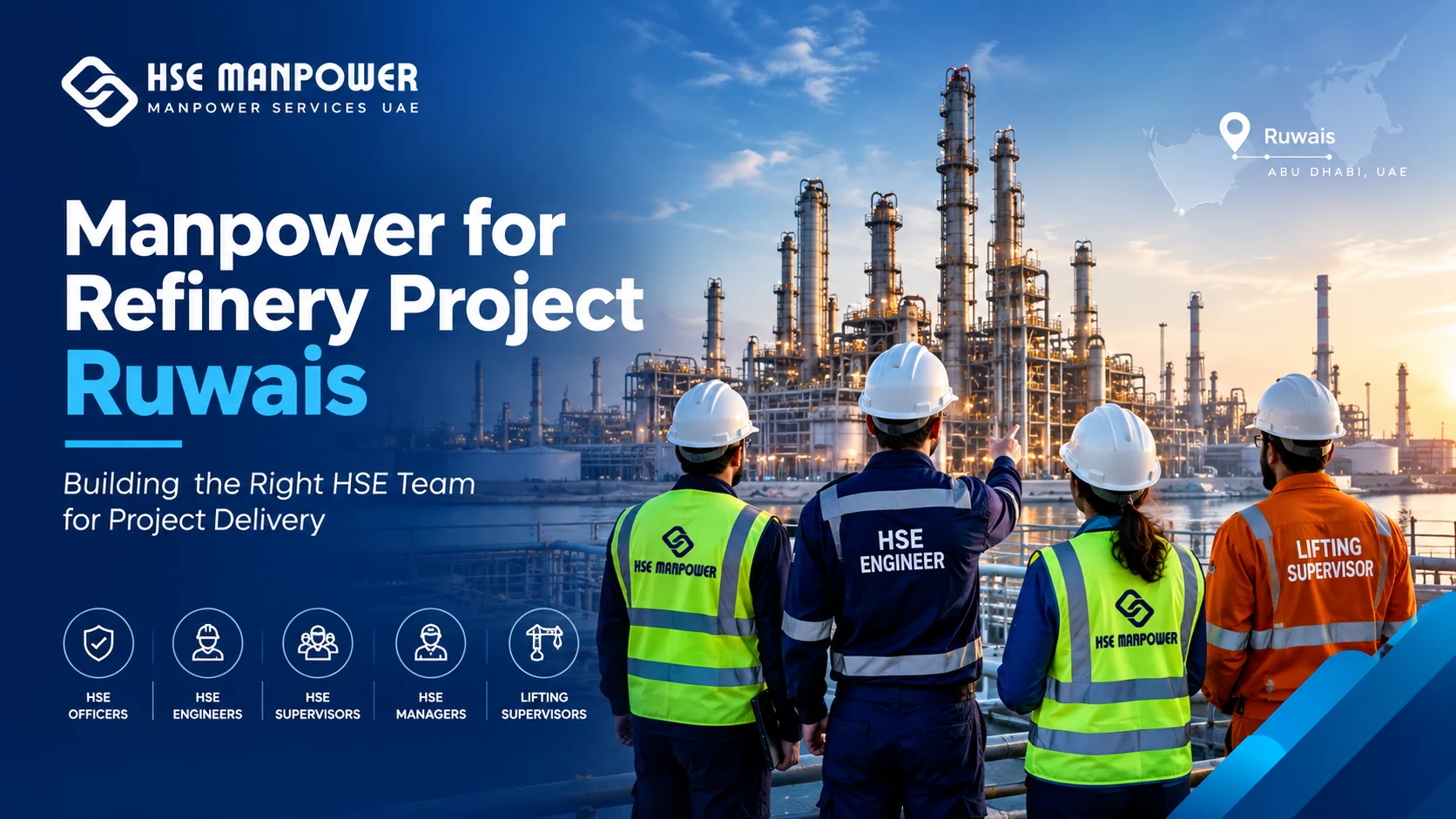
In a refinery project, manpower is not simply a matter of filling vacancies. The right people have to be available at the right project phase, with the right level of site experience, technical understanding, and safety responsibility.
This becomes particularly important when working around the Ruwais refinery and wider industrial ecosystem in Abu Dhabi, UAE. Ruwais is home to one of the world’s largest and most advanced refinery operations, with ADNOC stating that its Ruwais refinery processes more than 922,000 barrels per day. The scale and complexity of the industrial environment create demanding requirements for project contractors, EPC companies, subcontractors, and specialist service providers.
For companies looking for manpower for refinery project Ruwais, the real requirement is therefore not just “more workers.” It is a dependable project manpower structure that can support HSE compliance, field supervision, lifting activities, risk management, and safe execution throughout the project lifecycle.
HSE Manpower provides project and HSE staffing solutions across the UAE, including Safety Officers, HSE Engineers, HSE Supervisors, HSE Managers, and Lifting Supervisors. Its service model covers both short-term and long-term manpower requirements.
What does manpower for a refinery project in Ruwais actually involve?
Refinery projects can move through several distinct phases, including engineering support, construction, installation, maintenance, shutdown or turnaround activities, commissioning, and operational support.
The manpower requirement can change considerably between these phases.
A contractor may need:
- HSE Officers for day-to-day site monitoring
- HSE Engineers for technical safety coordination
- HSE Supervisors for field-level safety supervision
- HSE managers for project-wide HSE leadership
- Lifting supervisors for critical lifting and material-handling activities
- Additional project personnel during periods of increased workforce mobilization
- Short-term HSE manpower during shutdown, maintenance, or specialist activities
The important point is that refinery manpower planning should follow the project workload, not simply a fixed headcount.
That is where a specialized manpower partner can add value.
Why Ruwais refinery projects require a different manpower approach
A refinery environment combines multiple high-risk activities and interfaces within the same project environment.
Depending on the scope, contractors may be dealing with construction activities, heavy equipment, lifting operations, confined spaces, hot work, work at height, simultaneous operations, energy isolation, process-area interfaces, and other activities requiring close safety coordination.
Ruwais also has a broader industrial ecosystem surrounding refinery operations. ADNOC describes its Ruwais facilities as part of a major downstream and industrial environment serving domestic and international markets.
For project companies, this means HSE manpower must be capable of working within a structured, procedure-driven industrial environment rather than simply performing routine site inspections.
The value of the manpower is therefore measured by how effectively personnel integrate with:
- Project HSE plans
- Permit-to-work systems
- Risk assessments and method statements
- Toolbox talks and safety briefings
- Site inspections
- Incident and near-miss reporting
- Emergency response arrangements
- Lifting plans and lifting controls
- Contractor and subcontractor coordination
- Environmental requirements
- Project documentation and reporting
HSE manpower roles commonly required for refinery projects
1. HSE Officers
HSE officers provide frontline safety support at project sites.
Their responsibilities can include site inspections, monitoring work activities, identifying unsafe conditions, supporting toolbox talks, checking compliance with established procedures, and reporting safety observations.
For large refinery projects, the number of work fronts can change quickly. Having access to additional HSE officers can help contractors respond to changing workforce and worksite requirements.
2. HSE Engineers
HSE Engineers provide a more technical level of project safety support.
They can contribute to risk assessments, safety planning, compliance monitoring, inspection programs, incident investigations, and coordination between project teams.
For EPC and industrial contractors operating in Ruwais, experienced HSE engineers can be particularly valuable when multiple disciplines and subcontractors are working simultaneously.
3. HSE Supervisors
HSE Supervisors operate closer to the daily execution of site activities.
They help ensure that safety requirements are implemented in the field and that workers and supervisors understand the controls applicable to their activities.
This makes HSE Supervisors important for projects where multiple crews, contractors, or work fronts are active at the same time.
4. HSE Managers
An HSE Manager provides project-level leadership for health, safety, and environmental management.
For major refinery projects, the role can involve coordinating HSE teams, monitoring project performance, reviewing risk controls, supporting management decisions, and maintaining alignment between project execution and HSE objectives.
5. Lifting Supervisors
Lifting activities can introduce significant risk to refinery and industrial projects.
A competent lifting supervisor can provide dedicated oversight of lifting operations, helping coordinate safe execution and ensuring that lifting activities are properly controlled.
HSE Manpower specifically lists lifting supervisors among its manpower services and also has a dedicated Ruwais service page focused on temporary lifting supervisor deployment.
Why project-based HSE manpower can make commercial sense
One of the biggest challenges for EPC contractors and subcontractors is that manpower demand is rarely constant.
During mobilization, the requirement may be relatively limited.
During major construction activities, workforce levels can increase significantly.
During shutdowns, turnarounds, or intensive maintenance periods, the demand for experienced safety personnel can rise rapidly.
After a major work package is completed, maintaining the same permanent headcount may no longer be commercially efficient.
A project-based manpower model gives businesses greater flexibility to scale personnel according to actual project requirements.
For example:
Mobilization → Construction → Peak Execution → Shutdown/Turnaround → Commissioning → Demobilization
Each stage can require a different manpower profile.
Instead of treating manpower as a fixed overhead, contractors can plan it as a project resource that changes with workload and risk exposure.
What should companies check before choosing a refinery manpower supplier in Ruwais?
Price should not be the only selection criterion.
For refinery and oil & gas projects, procurement and project teams should consider several factors.
Relevant project experience
Does the manpower provider understand industrial, oil & gas, and project environments?
Role-specific capability
Can the supplier provide the exact category of personnel required rather than generic labor?
Mobilization capability
How quickly can suitable personnel be deployed when a project requirement changes?
Scalability
Can the supplier provide additional HSE personnel during peak periods?
Flexibility
Can manpower be supplied for short-term, contract-based, or longer project requirements?
Technical suitability
Do candidates have the experience and competencies required for the role and project environment?
Communication
Can the manpower provider coordinate effectively with the contractor’s HR, procurement, project, and HSE teams?
These factors can have a direct effect on project mobilization and execution.
Manpower for refinery project Ruwais: a better procurement model
For B2B buyers, the most effective approach is to define the requirement before requesting manpower.
A useful manpower request should identify:
Project location: Ruwais, Abu Dhabi, UAE
Project type: Refinery / Oil & Gas / Industrial
Project phase: Construction / Shutdown / Maintenance / Commissioning / Operations
Required roles: HSE Officers / HSE Engineers / HSE Supervisors / HSE Managers / Lifting Supervisors
Number of personnel: Required headcount
Contract duration: Short-term / Project-based / Long-term
Mobilisation date: Required deployment date
Work schedule: Shift pattern and working hours
Project requirements: Relevant certifications, experience, and client/site requirements
This allows the manpower supplier to understand the actual requirement instead of treating the request as a generic recruitment vacancy.
Why HSE Manpower is relevant to refinery project staffing in Ruwais
HSE Manpower’s service portfolio is built around project and HSE manpower requirements. The company provides safety officers, HSE engineers, HSE supervisors, HSE managers, lifting supervisors, and flexible staffing solutions.
Its website also specifically targets Ruwais, with services covering HSE engineering, temporary lifting supervision, and oilfield and safety roles.
This makes the company relevant for contractors that need to supplement an existing project team, mobilize additional safety personnel, or source project-based HSE resources for industrial work in the UAE.
The objective is straightforward: help project teams access the right safety manpower when the project requires it.
The real value of refinery manpower is project readiness
For an EPC contractor, project delays rarely come from a single issue.
Mobilization, procurement, engineering, construction, safety, logistics, and workforce coordination all influence project performance.
HSE manpower is one part of that larger execution system.
When the required HSE personnel are available before major work fronts begin, contractors can establish safety supervision alongside project execution rather than trying to build the safety structure after work has already accelerated.
That is particularly important in refinery environments where multiple activities may operate simultaneously.
The better question is therefore not
“How many HSE personnel do we need?”
It is:
“What HSE manpower structure does this project require at each stage of execution?”
That shift in thinking can make manpower planning more strategic, scalable, and aligned with project delivery.
Frequently Asked Questions
What manpower is required for a refinery project in Ruwais?
The requirement depends on the project scope and phase. Common HSE manpower categories include HSE Officers, HSE Engineers, HSE Supervisors, HSE Managers, and Lifting Supervisors. Additional personnel may be required during major construction, shutdown, turnaround, or commissioning activities.
Where can I find manpower for refinery projects in Ruwais?
Companies can work with specialized UAE manpower providers that supply project and HSE personnel for oil & gas and industrial environments. HSE Manpower provides project-based and long-term HSE staffing solutions across the UAE, including Ruwais.
Can HSE manpower be supplied for short-term refinery projects?
Yes. Project-based and short-term manpower can be useful when contractors need additional HSE personnel during specific work packages, shutdowns, maintenance activities, or periods of increased workforce mobilization.
What HSE roles can be supplied for a Ruwais refinery project?
Typical roles include HSE Officers, HSE Engineers, HSE Supervisors, HSE Managers, and Lifting Supervisors. The exact requirement should be determined by project scope, work activities, workforce size, and client requirements.
Why is local project manpower planning important in Ruwais?
Ruwais is a major industrial and refining location in Abu Dhabi. Its refinery and surrounding industrial operations involve complex project and operational environments, making structured HSE manpower planning important for contractors and project teams. ADNOC identifies Ruwais as one of its major refining locations and describes the refinery as one of the world’s largest and most advanced.
How can contractors request manpower for a refinery project in Ruwais?
Contractors can provide the manpower supplier with the project location, required roles, headcount, project phase, duration, mobilization date, shift pattern, and required qualifications. This allows the supplier to propose a manpower solution aligned with the project’s actual requirements.
Build the manpower plan around the project, not the other way around
Refinery projects require more than a large workforce. They require structured, competent, and scalable manpower that can respond to changing project conditions.
For contractors and EPC companies operating in Ruwais, the right HSE manpower partner can support mobilization, strengthen field-level safety supervision, and provide flexibility as project requirements change.
If your company is planning a refinery, oil & gas, maintenance, shutdown, or industrial project in Ruwais, HSE Manpower can support your requirements with project-focused HSE staffing solutions.
Need manpower for a refinery project in Ruwais? Contact HSE Manpower to discuss your project requirements and required HSE personnel.