
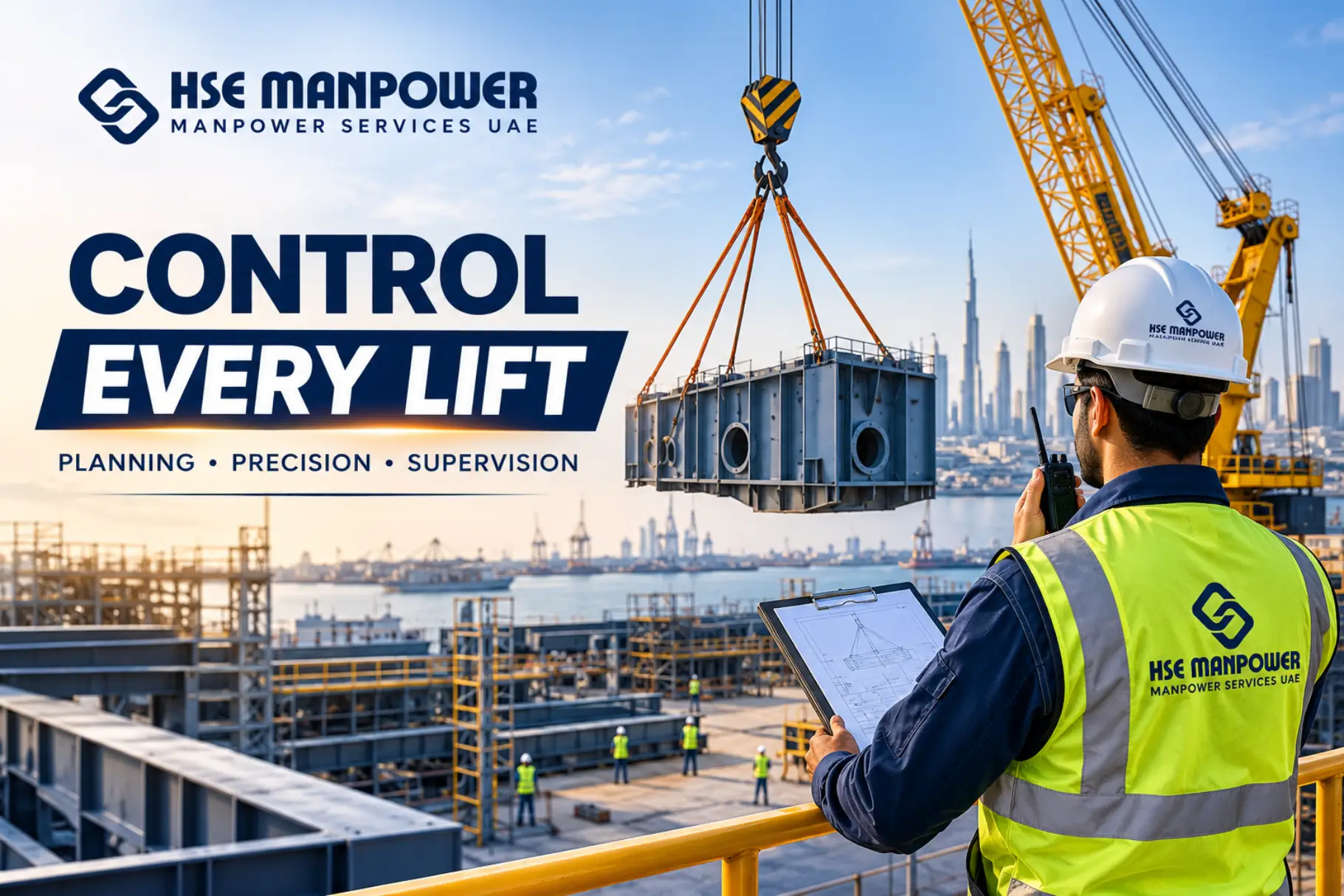
A crane can be positioned correctly, the lifting equipment can be available and the work area can be prepared. Yet these individual preparations do not automatically mean that a lifting operation is ready to proceed.
The real test comes when the different elements have to work together. The lifting arrangement must correspond with the actual site conditions, the equipment must be appropriate for the task and everyone involved must understand their respective responsibilities.
For construction contractors, EPC companies, industrial operators and project owners, this coordination is an important consideration when arranging Lifting Supervisor Manpower UAE.
The requirement goes beyond placing another person on the project workforce. It involves ensuring that the supervisory role fits the lifting activity, the operational environment and the responsibilities assigned to the lifting team.
As lifting requirements vary between construction, fabrication, oil and gas, ports and industrial operations, the manpower arrangement also needs to reflect the work being undertaken.
A lifting operation is a connected process, not an isolated activity
Consider a project preparing to move a heavy component from a designated storage area to an installation location.
The crane and lifting accessories may have been arranged, but several questions remain relevant before the operation proceeds.
Does the planned arrangement reflect the actual load and site conditions? Are the equipment and accessories consistent with the lifting requirements? Has the working area been considered? Does the team understand the communication arrangements? Who is responsible for supervising execution, and who has the authority to make decisions when conditions change?
These questions illustrate the relationship between planning, preparation and execution.
A lifting operation involves several connected responsibilities:
- The lifting arrangement must be appropriate for the intended task.
- The equipment configuration must correspond with the approved arrangement.
- Ground conditions and the operating environment must be considered.
- The lifting team must understand its responsibilities and communication arrangements.
- Supervisory control must be maintained throughout the activity.
When one of these elements changes, the original arrangement may need to be reviewed before work continues.
For project management teams, this makes lifting supervision part of the wider operational control system rather than a position that can be assessed only by headcount.
The difference between planning a lift and controlling its execution
One distinction deserves particular attention when businesses arrange lifting supervisor staffing: the difference between an Appointed Person and a Lifting Supervisor.
Although the two positions are closely connected, their responsibilities are not interchangeable.
Planning responsibility
Appointed Person
The Appointed Person is responsible for planning the lifting arrangement. This includes assessing the load, selecting suitable equipment, considering the lifting configuration, evaluating ground-bearing conditions, defining exclusion zones and preparing the lift plan and relevant method statement.
Execution responsibility
Lifting Supervisor
The Lifting Supervisor oversees the implementation of the lifting arrangement on site. This includes briefing the lifting team, checking equipment against the plan, confirming relevant site conditions, controlling the activity and stopping the operation when actual conditions no longer correspond with the planned arrangement.
Supporting lifting personnel
Riggers and Slinger-Signallers
These personnel handle the load and communicate signals to the crane operator under the lifting supervisor’s control.
Role distinctions reflect the responsibilities described in HSE Manpower’s published lifting service page.
This separation is particularly important for projects involving complex lifting arrangements.
A business requesting a supervisor should not automatically assume that the position also covers the technical responsibility for planning every lift. The required competence must correspond with the actual scope.
HSE Manpower’s published service information identifies all three personnel categories, including Appointed Persons, Lifting Supervisors and Riggers/Slinger-Signallers.
Where lifting conditions change, supervisory requirements change too
The operational demands of lifting activities are not identical across project environments.
A mobile crane operation within a defined construction area presents different site considerations from a tower crane installation, a fabrication-yard load-out or an offshore lifting activity.
The equipment, working area, surrounding operations and environmental conditions all influence the supervisory requirements.
The following examples illustrate the differences.
Construction and high-rise developments
Construction projects may involve mobile cranes, tower cranes, precast elements, structural steel and façade installation.
The relevant considerations can include crane positioning, exclusion zones, surrounding work activities and coordination between the lifting team and other site personnel.
Tower crane erection, climbing and dismantling also involve different operational considerations from routine lifting activities.
Fabrication yards and industrial facilities
Fabrication and industrial environments can involve heavy components, structural assemblies, equipment installation and module movement.
For certain assignments, the work may extend beyond conventional crane operations to include heavy transport, SPMT movements and skidding.
These activities require the relevant lifting and heavy-transport experience to be considered when defining the manpower requirement.
Oil and gas and offshore operations
Oil and gas projects may involve equipment installation, vessel handling, platform cranes and other lifting activities.
Offshore lifting introduces additional environmental considerations, including vessel movement and dynamic loading. Experience in land-based lifting should not automatically be treated as equivalent to offshore lifting experience.
The required personnel should therefore be assessed against the actual operating environment and the client’s requirements.
HSE Manpower’s lifting service page identifies construction, oil and gas, fabrication, ports, heavy industry and offshore lifting among its service-related environments and activities.
Equipment readiness and site conditions must remain connected
A lifting arrangement can only be meaningful when it corresponds with the equipment and conditions encountered during execution.
This is an important consideration for businesses engaging lifting safety personnel UAE.
For example, the equipment configuration identified in a lifting arrangement should be consistent with the actual crane and lifting accessories being used. Relevant third-party certification and inspection records should also be considered according to the applicable requirements.
Ground conditions are another important factor. Crane positioning, ground-bearing capacity and outrigger loading can influence whether the proposed arrangement is suitable.
The operating area also requires attention. Nearby structures, occupied areas, live plant, overhead services and restrictions on access may affect how the activity can be conducted.
For the Lifting Supervisor, the task is to maintain control of execution within the approved arrangement and escalate discrepancies rather than allow the activity to continue under conditions that differ from the plan.
For project managers, this reinforces the importance of connecting lifting supervision with the technical and operational information available before the work begins.
Communication is part of lifting control
During a lifting activity, the crane operator, Lifting Supervisor, Riggers and Slinger-Signallers must work within an understood communication arrangement.
This becomes particularly important where the operator does not have a direct view of the load or where the lifting activity requires signals to be relayed.
A breakdown in communication can create uncertainty about the movement of the load, the position of personnel or the next stage of the operation.
The supervisory arrangement should therefore establish:
- Who is responsible for directing the lifting activity.
- Which communication method and signals apply.
- How instructions are passed to the crane operator.
- How the team responds if communication is interrupted.
- Who has responsibility for stopping the activity when conditions become unsuitable.
These details are relevant to both routine and more complicated lifting arrangements.
A clear division of responsibilities helps avoid conflicting instructions and gives the lifting team a common understanding of how the activity is to be controlled.
Matching lifting manpower to the actual work scope
A project does not necessarily require the same combination of lifting personnel for every assignment.
Some requirements may involve a Lifting Supervisor for an activity covered by an existing, properly prepared lift plan. Others may require the involvement of an Appointed Person as well as supervisory and rigging personnel.
The distinction depends on the actual lifting scope and the level of planning and execution competence required.
For companies seeking Lifting Supervisor Manpower UAE, this is an important consideration when discussing manpower requirements with a staffing provider.
The discussion should establish:
| Project requirement | Relevant consideration |
| Routine crane lifting | Supervisory coverage and the existing lift arrangement |
| Tandem or multi-crane lifting | Planning competence and coordination between lifting teams |
| Blind lifting | Communication arrangements and relayed signalling |
| Heavy component installation | Equipment configuration and site conditions |
| Fabrication-yard load-out | Relevant load-out and heavy-transport experience |
| Offshore lifting | Offshore operating environment and applicable personnel requirements |
| Tower crane activities | Specific erection, climbing, operation or dismantling requirements |
This is not a universal staffing formula. It is a way of identifying the personnel categories and experience that should be considered before finalising the requirement.
HSE Manpower’s dedicated lifting service page discusses these different lifting activities and distinguishes between planning and execution responsibilities.
A manpower provider should understand more than the position title
For procurement and project teams, the quality of a lifting manpower arrangement depends partly on how clearly the actual assignment is communicated.
A request for a Lifting Supervisor may not provide sufficient information about the type of equipment, lifting activity, site conditions or personnel required alongside the supervisor.
A more useful enquiry should include:
- Lifting activity: Describe the operation, such as mobile crane lifting, tower crane work, module load-out or equipment installation.
- Equipment information: Provide the crane type and configuration where known.
- Site conditions: Explain the working environment, ground conditions and relevant operational restrictions.
- Team structure: Identify whether the requirement covers a supervisor alone or additional lifting personnel.
- Planning requirements: Clarify whether a lift plan already exists and whether an appointed person is required.
- Location and schedule: State the project location and intended assignment dates.
- Client requirements: Specify relevant qualifications, registrations, certifications and access conditions.
This information gives the provider a better understanding of the assignment and helps the business discuss the appropriate manpower categories.
It also reduces the possibility of confusing a Lifting Supervisor requirement with a broader requirement for an Appointed Person or complete lifting team.
Lifting Supervisor Manpower UAE for different project requirements
HSE Manpower lists Lifting Supervisors as a dedicated service category within its wider HSE manpower offering.
Its published lifting service information covers different operational requirements, including:
- Mobile crane lifting.
- Tower crane erection, climbing and dismantling.
- Overhead and gantry crane activities.
- Tandem and multi-crane lifts.
- Offshore and marine lifting.
- Heavy transport, SPMT movements and skidding.
- Module and skid load-out.
- Vessel and heavy-component installation.
- Turnaround lifting campaigns.
- Precast and structural steel erection.
The company’s location and service information also identifies lifting-related manpower pages for Dubai, Abu Dhabi, Sharjah, Fujairah, Ras Al Khaimah, Ruwais, Al Taweelah and Masdar City, among other locations.
The specific personnel and competence required remain dependent on the assignment and its applicable requirements.
Businesses can explore the company’s Lifting Supervisor Supply Across the UAE service page for further details.
The final consideration: define the lifting team around the operation
The effectiveness of a lifting arrangement depends on the relationship between planning, equipment, site conditions, communication and supervision.
Treating these as separate procurement considerations can make it difficult to establish whether the proposed manpower arrangement genuinely matches the activity.
For businesses planning construction, oil and gas, fabrication or industrial work, the more useful approach is to define the lifting operation first and then identify the personnel required to support it.
That includes distinguishing the planning responsibility of an Appointed Person from the execution responsibilities of a Lifting Supervisor and the supporting duties of Riggers and Slinger-Signallers.
HSE Manpower provides Lifting Supervisors and related lifting personnel as part of its wider manpower services in the UAE. Businesses with an upcoming lifting assignment, project-based requirement or need for additional lifting personnel can discuss their scope with the team.
The objective should be straightforward: establish the right lifting responsibilities before the operation reaches the execution stage.
Discuss your lifting manpower requirements with HSE Manpower
For project enquiries and lifting personnel requirements:
- Phone: +971 58 518 7072
- Email: info@hsemanpower.ae
- Location: 704E, IBN Battuta Gate Offices, Dubai, UAE
- Website: https://hsemanpower.ae/